
Introduction
The snake plant (Dracaena trifasciata, formerly Sansevieria trifasciata) is one of the most reliable houseplants found across Indian flats and modern urban homes. Often referred to as Mother-in-Law’s Tongue, it is widely celebrated for its architectural upright profile and its ability to withstand low-light city spaces. However, many apartment owners encounter a familiar set of challenges: upright foliage turning limp, leaf tips browning, or sluggish growth that fails to produce fresh, vibrant pups.
Achieving upright, firm, and glossy growth requires adapting basic snake plant care to local Indian apartment conditions specifically high ambient humidity during the monsoon, intense balcony heatwaves in summer, and low airflow inside air-conditioned rooms. This comprehensive snake plant care indoors handbook details how to care for snake plant at home, ideal soil mixes, seasonal watering cycles, and how to keep snake plant leaves healthy and upright all year round.
1. Botanical Overview
- Botanical Name: Dracaena trifasciata (syn. Sansevieria trifasciata)
- Family: Asparagaceae
- Plant Type: Evergreen perennial succulent / rhizomatous geophyte
- Growth Habit: Upright, stiff, vertical sword-shaped rosettes
- Height & Spread: 0.5–1.2 metres indoors in containers (can reach up to 1.5 metres in sheltered balconies); spread expands outwards through underground rhizome offsets (pups)
- Flower Colors: Pale green to creamy-white, tubular, strongly scented nocturnal blooms on an elongated raceme; rare indoors, typically appearing when root-bound in spring or early summer
- Foliage: Thick, fibrous, fleshy upright leaves with banded dark-green and light grey-green transverse patterns, often edged with distinct creamy-gold margins (Sansevieria trifasciata ‘Laurentii’)
2. Light Requirements
Light is a primary driver of leaf rigidity, growth rate, and variegation sharpness in indoor snake plants.
Ideal Lighting Conditions
- Optimal Light: Bright, indirect sunlight is best for maintaining structural leaf rigidity and fast pup generation. East-facing window sills or north-facing balconies sheltered from rain work well, providing plentiful ambient light without burning the foliage.
- Low Light Limitations: While snake plants are marketed as indestructible low-light houseplants, keeping them in dark corridors or windowless bathrooms slows metabolic activity to a crawl. Over time, low light leads to thin, floppy blades, faded yellow margins, and elongated, pale leaves that bend under their own weight.
- Sunburn Risks: Direct, harsh afternoon sunlight—particularly from March to June across Indian cities—scorches the waxy protective cuticle. This causes bleached white patches, dry brown sunken lesions, and irreversible dehydration.
3. Best Snake Plant Potting Mix India
Standard nursery chikni mitti (dense red or clay garden mud) compacts quickly in containers, choking root systems and causing rapid rhizome decay. An aerated, gritty, fast-draining snake plant potting mix keeps underground rhizomes firm and oxygenated.
| Ingredient | Proportion | Function |
| Garden Loam / Clean Garden Soil | 20% | Base anchor, mineral stability, and moderate nutrient buffer |
| Vermicompost or Well-Rotted Gobar Khad | 20% | Slow-release, mild organic nutrition that promotes steady foliage growth |
| Coarse River Sand / Pumice / Perlite | 30% | Essential drainage channels; prevents water retention around the crown |
| Crushed Brick Chips / Biochar / Gravel | 30% | Porosity, aeration, and prevents soil compaction around thick rhizomes |
| Soil mix components, ratio and its benefits |
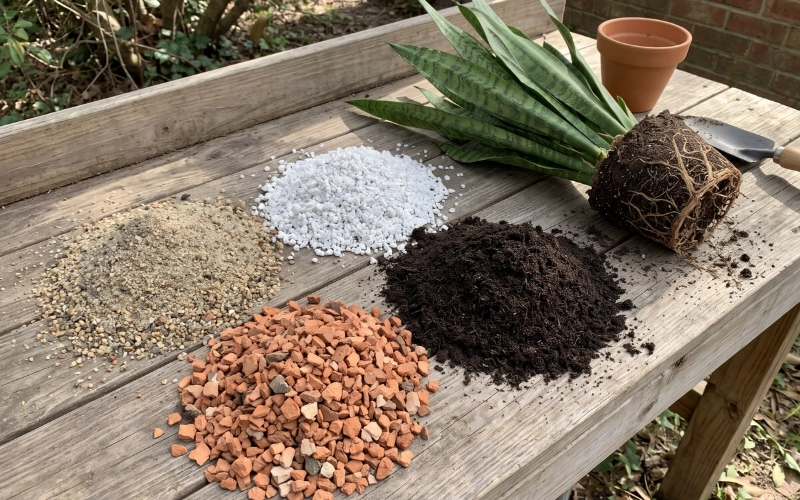
brick chips-Left down)
Always pot snake plants in heavy ceramic planters, unglazed terracotta pots, or high-grade drainage gamlas with clear, unobstructed base holes to allow excess water to escape immediately.
4. Snake Plant Watering Schedule: Summer, Monsoon, and Winter
A strict calendar schedule often leads to overwatering and fungal decay. Instead, rely on a wooden moisture skewer or the knuckle test, adapting your watering routine to the Indian seasonal cycle:
- Summer (March–June): Hot summer temperatures and dry winds speed up soil moisture evaporation. Check planters once every 7 to 10 days; water deeply only when the soil is completely dry from top to bottom.
- Monsoon (July–September): Ambient relative humidity remains elevated (75–90%), meaning indoor soil retains moisture for weeks. Water sparingly, roughly every 2 to 3 weeks, verifying that the root zone is bone-dry before re-watering to prevent stem rot.
- Winter (November–January): Plant metabolism slows, especially across North and Central India where nighttime temperatures dip significantly. Water once every 3 to 4 weeks. If the weather is overcast and cold, hold off until warmer sunny intervals.
5. Best Fertilizer for Snake Plant at Home
Snake plants are light feeders with low nutritional demands. Excess nitrogen causes leaf blades to turn soft and topple over. The best fertilisation schedule focuses on light, balanced inputs during the active growing season (late February to mid-October):
- Vermicompost: Top-dress 1 to 2 tablespoons of organic vermicompost or composted cow manure (gobar khad) around the pot perimeter once every 6 to 8 weeks. Lightly loosen (gudai) the top inch of soil before watering.
- Balanced Liquid Feed (NPK 19:19:19): Dilute 1 gram (quarter teaspoon) in 1 litre of water and apply to the root zone once every 6 to 8 weeks during spring and monsoon. Avoid splashing concentrated fertilizer directly into the central rosette.
- Seaweed Extract: A mild seaweed extract drench (2 ml per litre of water) applied once a quarter delivers trace micronutrients that enhance cellular leaf strength.
- Winter Dormancy: Stop all fertilisation completely from November through January to avoid root burn while growth is paused.
6. Snake Plant in Water vs Soil: Comparative Overview
Understanding the distinct differences between cultivating snake plants in water versus traditional soil helps you choose the right growing method:
- Growing in Water: Ideal for water propagation, tabletop glass vases, and minimalist room accents. Leaf cuttings root well in clean, dechlorinated water placed in bright indirect light. Replace water completely every 7 to 10 days to inhibit algal build-up and mosquito larvae. Note that while water propagation is effective for rooting, mature plants grown indefinitely in water remain compact and rarely produce large vertical leaf clusters.
- Growing in Soil: Soil cultivation is the standard way to grow full, multi-stem specimens with wide foliage and underground runners. Porous potting mediums provide the physical resistance, aeration, and organic nutrition rhizomes need to push up vigorous new pups.
7. How to Make Snake Plant Bushy and Grow Big Leaves
Transforming a lone, sparse cutting into a dense, upright statement plant relies on practical structural and cultural techniques:
7.1. Provide Bright Ambient Light to Accelerate Pup Formation
While snake plants tolerate dim interiors, placing them in bright, indirect light stimulates root hormonal activity. Increased light accelerates rhizome division, prompting the mother plant to produce multiple secondary shoots (pups) in the same season.
7.2. Keep the Root Zone Snug in a Sturdy Planter
Snake plants grow best and produce more vertical shoots when slightly root-bound. Choose a sturdy planter that allows only 1 to 2 inches of room around the root ball. Loose, oversized containers retain too much moisture, which slows pup production and increases the risk of root rot.
7.3. Cluster Rooted Rhizomes During Potting
To achieve an instant lush, full look, pot 3 to 5 rooted rhizome segments or matured leaf rosettes together in a wide, shallow terracotta container. Staggering leaf heights produces an immediate dense silhouette while individual root balls establish themselves.
8. Diagnosing Common Snake Plant Problems
- Soft, Wrinkled, or Drooping Leaves: Typically caused by extended dehydration, or conversely, severe root rot that prevents water uptake. Check root condition: if roots are white and brittle, deep watering will rehydrate the leaves; if roots are dark brown and mushy, root rot has set in.
- Curling or Creased Foliage: Often triggered by prolonged exposure to strong dry winds from ceiling fans, direct hot loo breezes, or continuous air-conditioning drafts that leach leaf moisture.
- Loss of Golden Variegation: Distinct yellow borders fading to uniform dull green indicates insufficient light. Move the container closer to a bright east- or north-facing window.
- Splitting Leaf Blades: Physical trauma or irregular watering cycles where extended severe droughts are followed by heavy drenching, causing internal hydrostatic pressure changes.
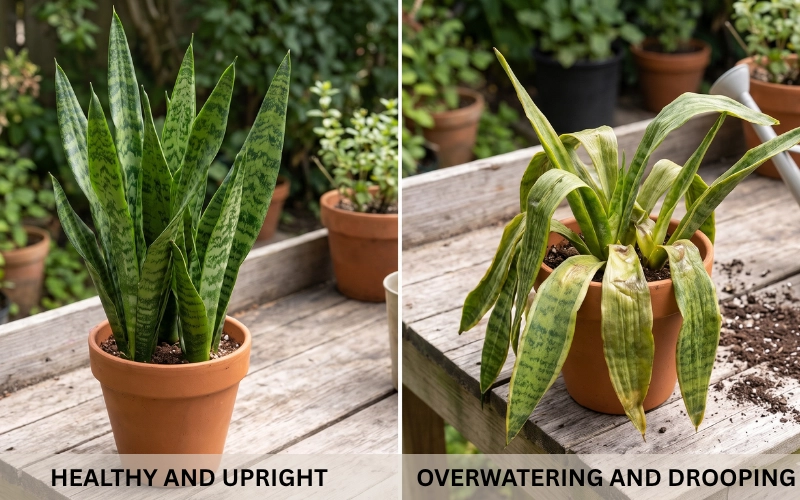
9. Snake Plant Pests and Diseases: Quick Identification and Treatment Guide
| Pest / Disease | Key Symptoms | Main Cause | Best Treatment & Indian Home Remedies |
| Mealybugs (Pseudococcidae) | White, waxy cotton-like masses deep inside the central rosette folds; leaves yellowing at the base | Dry indoor environments, stagnant room airflow, unventilated flats | Dip a cotton bud in surgical spirit or rubbing alcohol to dab and wipe away pests. Follow with a spray of 5 ml neem oil and 3 drops liquid dish soap per litre of water every 7 days. |
| Spider Mites | Fine, delicate webbing between upright leaves; dusty, stippled or yellowing leaf surfaces | Hot dry conditions, lack of humidity, prolonged dry summer spells indoors | Wipe down both sides of each leaf blade with a damp microfibre cloth. Spray with cold-pressed neem oil emulsion twice weekly until cleared. |
| Scale Insects | Waxy, immobile brown crusts adhering firmly to leaf surfaces; sticky honeydew exudate | Infested nursery plants, low-light indoor corners with poor ventilation | Scrape scales away gently using an old toothbrush dipped in a mild liquid dish soap solution. Wipe clean with a damp towel. |
| Fungus Gnats | Tiny black gnats hovering above wet soil; weakened, sluggish root formation | Continuously moist topsoil, poor potting drainage, decomposing organic matter | Allow the potting medium to dry out completely. Top-dress the pot with 2 tablespoons of organic neem khali (neem seed cake powder) to kill fly larvae. |
| Root Rot (Pythium / Phytophthora) | Mushy base, foul smell, leaves collapsing at the soil line, black liquefied roots | Chronic overwatering, heavy clay soil, lack of functional drainage holes | Unpot immediately and trim off all rotted, brown tissue with sterilized shears. Dust the healthy root cuts with systemic fungicide (Saaf / Bavistin) or pure haldi (turmeric powder); repot in fresh, gritty soil. |
| Red Leaf Spot (Bipolaris / Colletotrichum) | Sunken reddish-brown circular spots with yellowish margins on leaves | Water trapped inside the rosette crown; wet foliage in stagnant conditions | Avoid pouring water into the leaf crown. Cut off severely spotted foliage and spray leaves with a solution of 2 grams Saaf fungicide per litre of water. |
| Southern Blight (Sclerotium rolfsii) | Soft, water-soaked brown decay at the soil line; white fan-like fungal threads | Warm temperatures combined with high potting dampness during the monsoon | Discard affected plant tissue. Drench the remaining root zone with systemic copper-based or carbendazim fungicide; move the plant to a breezy location. |
10. Propagation Methods
- Identify Healthy Leaf Cuttings: Successful propagation starts by selecting clean, mature leaves from a healthy mother plant. Use a sterile razor blade to take straight 4- to 6-inch horizontal leaf cuttings.
- Callus Cuttings Before Planting: Allow the fresh cuts to air-dry and callus over in a shaded spot for 2 to 3 days. This creates a protective seal that prevents fungal entry before planting.
- Root in Water with Patience: Place callused cuttings vertically in a clean glass jar filled with 2 inches of water. Change the water weekly and keep the jar in indirect light; roots will typically emerge within 4 to 6 weeks.
- Propagate via Rhizome Division for True Variegation: Note that leaf cuttings of variegated cultivars (like Laurentii) revert to solid green. To retain creamy-yellow margins, propagate by unpotting the mother plant and cutting the thick underground rhizome cleanly with roots attached.
- Potting Rooted Offsets: Repot divided pups into an aerated, gritty succulent mix, moisten lightly, and keep in warm, bright ambient conditions to encourage steady rooting.
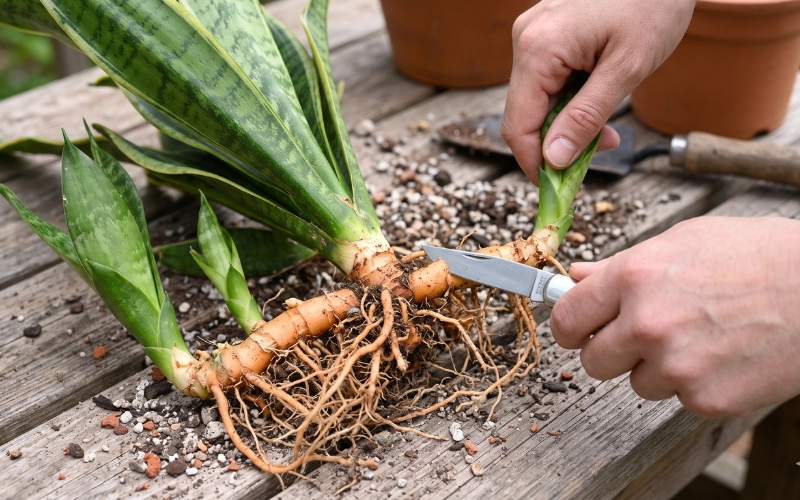
11. Indoor vs Outdoor Growing
11.1. Indoor Growing
- Ideal for bedrooms, home offices, and living rooms, where its upright form fits into tight spaces without blocking walkways.
- Functions well as an easy-care statement houseplant that thrives despite occasional underwatering.
- Protect indoor plants from direct cooling drafts generated by split air conditioners.
11.2. Outdoor Growing
- Well suited for covered balconies, shaded verandahs, and sheltered patio landscapes.
- Fits neatly into container gardens, boundary planters, and raised architectural beds.
- Protect outdoor plants from torrential monsoon downpours and scorching mid-day summer sun.
12. Landscaping and Decorative Uses
- Contemporary architectural container accents for living room corners.
- Desktop and side-table displays using dwarf varieties (such as Sansevieria hahnii).
- Balcony screen plantings and privacy dividers using tall ceramic troughs.
- Complementary succulent arrangements paired with jade plants and Zamioculcas zamiifolia (ZZ plants).
Conclusion
Throughout this handbook, we walked through every critical step needed to master snake plant upkeep from perfecting moisture levels and soil blends to balancing sunlight, rooting new cuttings, trimming damaged foliage, and tackling stubborn pests.
Putting these practical habits into action allows us to keep our foliage vigorous, dense, and continually expanding with fresh green growth.
Whether we are potting our very first houseplant or managing a seasoned indoor jungle, this forgiving succulent remains one of the most resilient, satisfying greens we can invite into our living spaces.
Frequently Asked Questions (FAQs)
Q1: How often should I water my snake plant in an Indian apartment?
A: As a general rule, water only when the potting mix is dry all the way to the bottom. In summer, this typically means once every 7 to 10 days; during the humid monsoon, reduce watering to every 2 to 3 weeks; and in winter, water sparingly every 3 to 4 weeks.
Q2: Why are my snake plant leaves turning soft, mushy, and falling over?
A: Soft, mushy leaves are almost always a symptom of overwatering or dense, waterlogged soil leading to root rot. Stop watering immediately, remove the plant from its container, snip away rotted black roots, dust healthy sections with fungicide powder, and repot into fresh, gritty soil.
Q3: Can snake plants survive in dark bedrooms with no windows?
A: Snake plants can tolerate dim spaces longer than most houseplants, but they cannot survive indefinitely in zero natural light. Without regular light, growth stalls, foliage softens, and the plant becomes vulnerable to rot. Place them in bright indirect light or rotate them under grow lights or near a sunny window every two weeks.
Q4: Why did my variegated snake plant cutting grow back completely green?
A: Variegated cultivars like Dracaena trifasciata ‘Laurentii’ carry their yellow striping through specific cell layers (chimeras). Propagating via leaf cuttings bypasses these mutated cells, producing solid green plants. To preserve yellow margins, always propagate through rhizome division rather than leaf cuts.
Q5: Is snake plant safe for pets at home?
A: Snake plant leaves contain insoluble saponins, which can cause mild mouth irritation, drooling, nausea, and stomach upset if chewed by cats or dogs. Keep pots elevated on plant stands or out of reach of curious house pets.
